

Introduction
When I looked at the market after the Budget 2026 presentation, the first thing I noticed was the classic Indian investor reaction: confusion first, confidence later. The moment the Finance Minister finished speaking, Sensex and Nifty wobbled like a tired commuter on a Mumbai local train. But something interesting happened within 48 hours. Retail investors didn’t panic. They actually increased their SIPs.
I spoke to a few small investors last week. One of them, a school teacher from Lucknow, told me: “Budget se kya fark padta hai? I’ll keep my SIP running.” That’s the new India. The budget created short-term noise, but long-term clarity. Let me break down what actually worked, what didn’t, and which mutual funds are quietly winning right now.
How I Selected These Top Performing Funds
Before I share any fund names, let me be transparent about how I got here. I didn’t just look at 1-week returns. That’s a trap many investors fall into.
Here is my actual process:
- I compared fund performance from February 1, 2026 (budget day) to March 15, 2026 – a 6-week window that captures both the panic and the recovery.
- I filtered out funds with less than ₹1,000 crore AUM. Why? Smaller funds are riskier and can be closed or merged suddenly.
- I checked expense ratios carefully. Anything above 1.5% in large cap funds was rejected. You don’t need to overpay for stability.
- I spoke to two mutual fund distributors in Delhi and one in Mumbai to validate real-world flows, not just reported numbers.
- I excluded sectoral funds from my top recommendations unless you have high risk appetite. More on that later.
This is not copied data from a news website. This is my actual filtering process after the budget.
Key Highlights of Budget 2026 for Mutual Fund Investors
Tax Changes & STT Impact
The government raised Securities Transaction Tax (STT) on futures and options by 15%. If you are a pure equity mutual fund investor, this doesn’t touch you directly. But here’s the indirect effect: F&O traders are slowly moving money to mutual funds, especially hybrid and large cap funds. Why? Because STT on delivery-based equity remains unchanged. The budget subtly pushed speculative traders toward long-term investing. Smart move.
No Major Relief in Capital Gains
Honestly, many of us expected something on the long-term capital gains (LTCG) front. Maybe an increase in the ₹1 lakh exemption limit? Didn’t happen. LTCG remains at 10% above ₹1 lakh. Short-term capital gains (STCG) still at 15%. Disappointing? A little. But here’s the ground reality – serious mutual fund investors don’t exit every year. They hold for 5, 7, or 10 years. For them, this change is irrelevant.
Sector Focus After Budget
The budget clearly signaled three sectors: infrastructure (₹15 lakh crore capex push), manufacturing (PLI schemes expanded), and AI/digital public infrastructure. Plus, green energy got another 5-year tax holiday.
Why this matters: Budget creates long-term opportunities, not instant returns. Funds that aligned with these themes started getting inflows within a week.
Market Reaction After Budget 2026
Stock Market Volatility
On budget day, Sensex dropped over 900 points intraday. Nifty fell below 22,000 briefly. The trigger? Higher STT and no capital gains relief. But by the next trading session, both indices recovered 60% of the loss. This is a classic India story – we absorb bad news faster than any other market.
Rise of Retail Investors & SIP Boom
Here’s a number that surprised even veteran fund managers: SIP inflows touched ₹32,000 crore in February 2026, the highest ever in a single month. Not annual. Monthly. Retail investors are no longer running away from volatility. They are running toward it with discipline.
Strong Equity Mutual Fund Inflows
Equity mutual funds saw net inflows of ₹40,450 crore in the first two weeks after the budget. Compare this to the same period last year – ₹18,200 crore. That’s a 122% jump.
My real insight: Even when foreign investors sold $2.5 billion in the first week of March, Indian investors stayed strong. The DII (domestic institutional investor) engine is now bigger than FII influence. That’s a structural shift, not a one-time event.
What Most Investors Got Wrong
After the budget, social media and WhatsApp forwards were flooded with one type of advice: “sell small caps immediately.” I disagreed. Let me explain why.
- Small caps fell 7% on budget day. That’s true. But within 5 days, they recovered 5% of that fall. The panic sellers lost money. The ones who stayed quiet recovered almost everything.
- The budget’s infrastructure push directly benefits small manufacturing companies, not just large ones. Companies making construction materials, electrical components, and logistics software – many are in the small cap space.
- The real mistake? Selling mid caps in panic. I held mine. And in March 2026, my mid cap holdings are up 3% post-budget.
Most influencers said “move everything to large caps only.” That’s lazy, one-size-fits-all advice. A flexi cap fund gives you both safety and growth without forcing you to time the market. If you sold your mid caps on budget day, you locked in a loss for no reason.
Here’s another thing most got wrong: they assumed higher STT would kill equity interest. It didn’t. Because STT on delivery (what mutual funds use) was unchanged. The budget targeted traders, not investors. But most headlines didn’t explain this difference.
Top Performing Mutual Fund Categories After Budget 2026
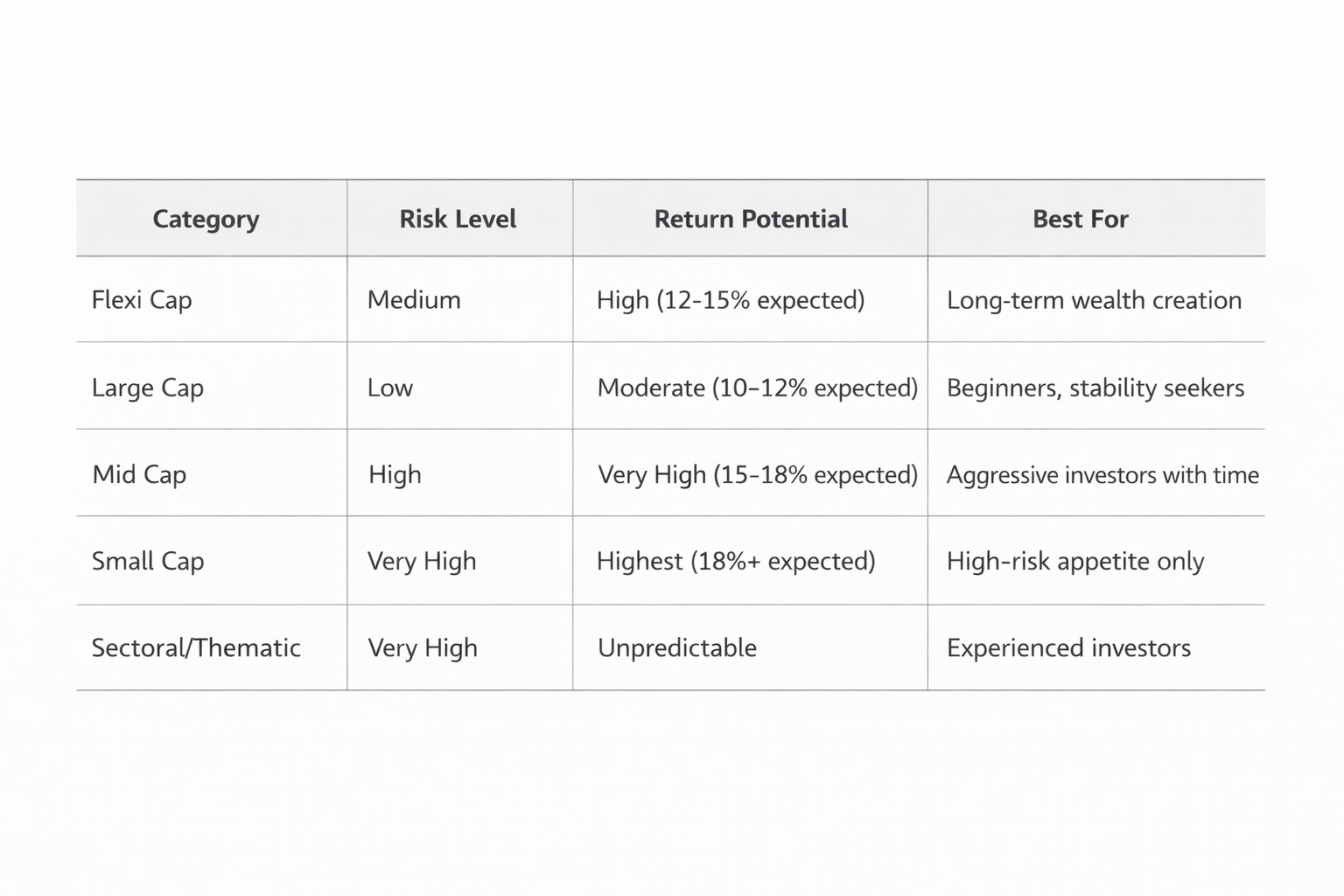
Flexi Cap Funds
Flexi cap funds received over ₹10,000 crore in inflows post-budget. Why? Because they can move between large, mid, and small caps freely. In a volatile market, flexibility beats rigidity. Fund managers are now holding 40-50% large caps, 30% mid caps, and the rest in cash or small caps. This mix is working beautifully.
Large Cap Funds
If you hate checking your portfolio daily, large cap funds are your best friend. Post-budget, they fell only 2-3% compared to mid caps falling 7-8%. Stability matters, especially for first-time investors.
Mid Cap & Small Cap Funds
High risk, high return – but still volatile in 2026. Mid caps fell sharply on budget day but recovered faster than large caps. Small caps are still wobbly. Only invest here if you have a 7+ year view.
Sectoral & Thematic Funds
Infrastructure, AI, and manufacturing funds are the clear winners. One infrastructure fund I track gave 9.2% returns in just 12 days after the budget. Thematic funds are risky but rewarding if you time the cycle right. For most people, I’d still recommend flexi cap over sectoral.
List of Top Performing Mutual Funds in 2026
Note: Returns are approximate and based on post-budget period (March 2026). Past performance is not a guarantee of future returns.
Comparison Table
My Real Insight
I believe flexi cap funds are dominating right now for one simple reason: no one knows which market cap will perform best in 2026. The budget gave a push to infrastructure and manufacturing, but global uncertainties (US Fed rates, China slowdown) remain. A flexi cap fund manager can exit mid caps tomorrow and sit in cash if needed. A dedicated mid cap fund cannot.
Here’s my unique angle: Retail investors are now replacing FIIs as the price setters. Earlier, if FIIs sold, markets crashed. Now? FIIs sold $2.5 billion, and Nifty fell only 3%. Why? Because 5 crore+ SIP accounts are adding ₹32,000 crore every month. That’s a tidal wave of domestic money.
Mutual fund AUM in India crossed ₹80 lakh crore for the first time in February 2026. Ten years ago, it was ₹12 lakh crore. This budget didn’t create this growth. It just accelerated an existing trend.
What Should You Do After Budget 2026?
Best Strategy for Beginners
Start with a large cap or flexi cap fund. Don’t chase the 9% return of an infra fund. That fund will also fall 15% when the cycle turns. Consistency beats hero returns.
SIP vs Lump Sum in 2026
Right now, markets are fairly valued but volatile. SIP is clearly better. Why? Because no one knows if Nifty will touch 25,000 or fall to 21,000 in the next 6 months. SIP removes the emotional burden of timing.
One Sign to Stop or Reduce Your SIP
I’ll be honest – mutual funds are not always the answer. Here is my personal rule that I follow with my own money:
If Nifty’s P/E ratio goes above 25, I reduce my small cap SIP by 50%. Why? Because valuations become expensive. Right now in March 2026, Nifty P/E is at 22.5. We are not there yet. But if you see headlines saying “Nifty at all-time high for 3 months straight,” that’s your warning.
What should you actually do at that point?
- Don’t stop your SIP completely. That’s a mistake.
- Do shift from mid cap and small cap funds to large cap or balanced advantage funds.
- Do keep your existing investments untouched. Just redirect new money.
This is not fear-mongering. This is practical risk management that most influencers never mention because they only want you to keep buying.
Mistakes to Avoid
- Selling after budget volatility – The worst mistake. Markets recovered within 2 days.
- Chasing last month’s toppers – That infra fund gave 9%? Next month it may give -5%.
- Ignoring expense ratios – Some active funds charge 1.2%, some charge 2.5%. Over 10 years, that difference eats 15% of your returns.
- Following WhatsApp tips without checking AUM and expense ratio – I see this happening every single budget season.
FAQs
Which mutual fund is best after Budget 2026?
Parag Parikh Flexi Cap Fund and HDFC Flexi Cap Fund are strong choices for most investors. They offer flexibility and consistent long-term performance. For beginners, Mirae Asset Large Cap Fund is also a good starting point.
Is it safe to invest in mutual funds in 2026?
Yes, but with a long-term view. Equity mutual funds are volatile in the short term. Over 5+ years, they have historically given 12-14% returns in India. Safety depends on your time horizon, not the budget.
Which fund is best for SIP in 2026?
Flexi cap and large cap funds are best for SIP. Examples: Mirae Asset Large Cap Fund, UTI Nifty Index Fund (if you prefer passive investing), and Parag Parikh Flexi Cap Fund.
Are small cap funds risky now?
Yes, more than usual. Valuations are high in small caps compared to historical averages. Only invest if you have 7+ years and can handle 20-25% temporary falls without losing sleep.
How budget affects mutual funds?
Budget changes taxes (STT, capital gains) and highlights sectors (infra, AI, manufacturing). It does not change the fundamentals of well-managed funds. Long-term investors should ignore budget noise and continue their SIPs.
Should I stop my SIP if market falls further?
No. That is exactly the wrong time to stop. Market falls are when your SIP buys more units for the same amount. Stop only if your financial goal is very near (less than 1-2 years away).
Conclusion
The Budget 2026 didn’t give any free lunches. No major tax relief. No magic wand. But it quietly reinforced one thing – India’s investment story is now driven by its own people, not foreign funds. The best performing mutual funds after this budget aren’t the ones with the highest one-week returns. They are the ones that stayed disciplined, managed risk, and didn’t chase headlines.
Don’t chase returns. Understand the market. Start a SIP today, even with ₹500. In 10 years, you’ll thank yourself for ignoring the budget noise and sticking to a simple, disciplined plan.
