

Growing a business without a clear financial roadmap is like driving in the dark with no headlights. You might move forward, but you’ll likely hit a few bumps, or worse, a dead end.
That’s where Financial Planning and Analysis (FP&A) comes in. It helps you see the road ahead, avoid potholes, and reach your goals faster.
In this guide, I’ll walk you through practical strategies to use Financial Planning and Analysis for real business growth. You’ll learn what works, what doesn’t, and how to avoid common mistakes, all in simple, human language.
What Is Financial Planning and Analysis?
Financial Planning and Analysis is the process of budgeting, forecasting, and analyzing financial data to help businesses make smarter decisions. It connects your company’s past performance with future goals.
Think of it as your financial GPS. It tells you where you are, where you’re going, and whether you need to change direction.
Key parts of FP&A include:
- Budgeting
- Financial forecasting
- Cash flow analysis
- Financial modeling
- Business financial analysis
- Strategic financial planning
When done right, Financial Planning and Analysis turns numbers into action. It helps you answer questions like: Can we afford to hire new people? Should we launch that product? What happens if sales drop by 10%?
Why Financial Planning and Analysis Drives Business Growth
You might think FP&A is only for big corporations. That’s not true. Small and medium businesses benefit just as much, often more.
Here’s how Financial Planning and Analysis directly supports growth:
1. Better Cash Flow Management
Cash is king. FP&A helps you predict when money will come in and when it will go out. That way, you avoid surprises like running out of cash before a big client pays.
2. Smarter Investment Decisions
Should you buy new equipment or hire a sales team? Financial Planning and Analysis helps you compare options using financial modeling and scenario analysis.
3. Faster Response to Change
Markets shift. Costs rise. Customers leave. With regular financial forecasting, you spot trends early and adjust before problems grow.
4. Stronger Team Alignment
When everyone sees the same financial plan, departments work toward the same goals. Sales knows the target. Operations knows the budget. Marketing knows the ROI they need to deliver.
Key Components of Effective Financial Planning and Analysis
To grow your business, your FP&A process needs a few core pieces. Let’s break them down.
Budgeting and Forecasting
Budgeting sets the plan. Forecasting updates it. Together, they keep you on track.
- Budget: Your financial target for the year.
- Forecast: Your updated prediction based on real results.
Many businesses update their forecast monthly. That’s smart. It keeps Financial Planning and Analysis relevant, not just a dusty spreadsheet.
Financial Modeling
A financial model is a math-based tool that shows how different choices affect your bottom line. For example:
- What happens if we raise prices by 5%?
- How many units must we sell to break even on a new product?
- What’s the impact of a 20% increase in raw material costs?
Good models help you test ideas without risking real money.
Cash Flow Analysis
Profit doesn’t pay bills, cash does. Cash flow analysis shows you exactly when money enters and leaves your business. That’s essential for growth. Growing too fast without enough cash is a common way small businesses fail.
Financial Performance Analysis
This means comparing actual results to your plan. Where did you beat expectations? Where did you fall short? Then, ask why. That “why” is where learning and improvement live.
Benefits of Strong Financial Planning and Analysis
Let’s look at the real benefits you can expect.
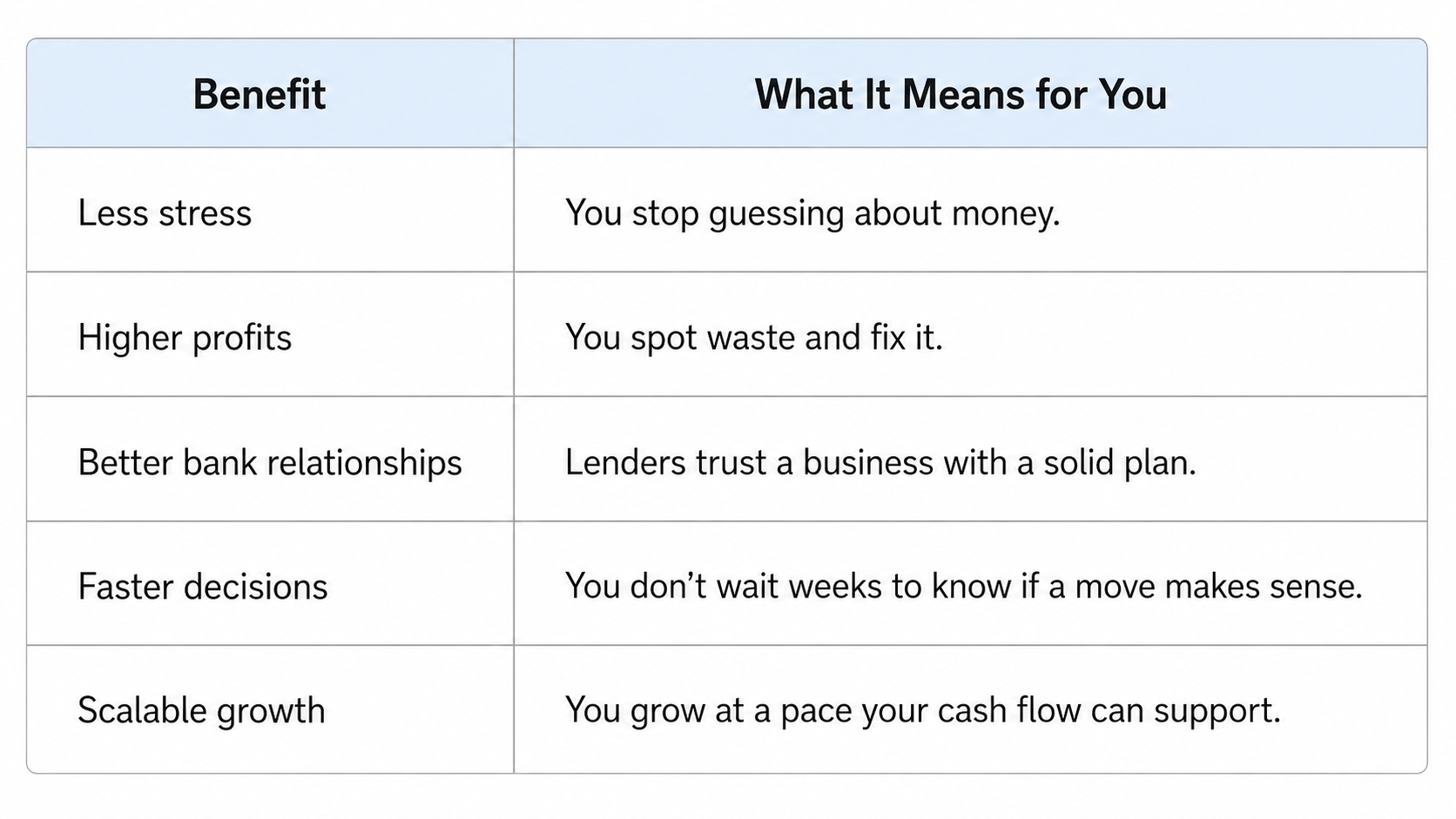
One retail client I worked with started basic Financial Planning and Analysis, and within six months, they found $40,000 in unnecessary costs. They reinvested that into marketing and grew revenue by 22% the next year.
That’s the power of FP&A.
Common Financial Planning and Analysis Mistakes (And How to Avoid Them)
Even smart business owners make FP&A errors. Here are the most common ones.
Mistake 1: Planning Only Once a Year
The world changes fast. An annual budget is outdated by month two.
Fix: Update your forecast monthly. Make Financial Planning and Analysis a weekly or monthly habit.
Mistake 2: Ignoring Cash Flow
Some businesses focus only on profit. But profitable companies can still go bankrupt if cash is tied up in unpaid invoices or excess inventory.
Fix: Do a cash flow forecast every week. Know your cash runway at all times.
Mistake 3: Overcomplicating the Process
You don’t need a ten-page spreadsheet with 50 tabs. Simplicity wins.
Fix: Start with three things: income forecast, cash flow forecast, and a simple budget vs. actual report.
Mistake 4: Keeping Finance in a Silo
FP&A fails when only the finance person understands it.
Fix: Share key numbers with department heads. Teach them how to read and use the data.
Mistake 5: Using Unrealistic Assumptions
“Sales will grow 30% because we hope so” is not a plan.
Fix: Base assumptions on past data and market research. If you’re unsure, use three scenarios: optimistic, realistic, and pessimistic.
Expert Tips for Better Financial Planning and Analysis
Here’s what experienced FP&A professionals do differently.
1. Start with the End in Mind
Ask: What business problem are we trying to solve? Don’t build models just to build models. Link every analysis to a decision.
2. Use Rolling Forecasts
A rolling forecast extends every month, say, always looking 12 months ahead. It keeps your Financial Planning and Analysis current without starting over each quarter.
3. Automate Data Collection
Manual data entry wastes time and invites errors. Use tools like Power BI, Tableau, or even simple connectors in Excel to pull data automatically.
4. Focus on Key Drivers
Not every number matters equally. Identify the 5–7 key drivers of your business (e.g., number of customers, average sale price, churn rate) and track those relentlessly.
5. Make It Visual
Spreadsheets are fine. Charts are better. Dashboards are best. When people see trends, they understand faster. Use simple line charts for trends and bar charts for comparisons.
6. Run “What-If” Scenarios Regularly
Once a month, ask: What if our top customer leaves? Or what if a key supplier raises prices by 15%? Then model the answer. You’ll sleep better knowing you have a plan.
How to Start Financial Planning and Analysis Today
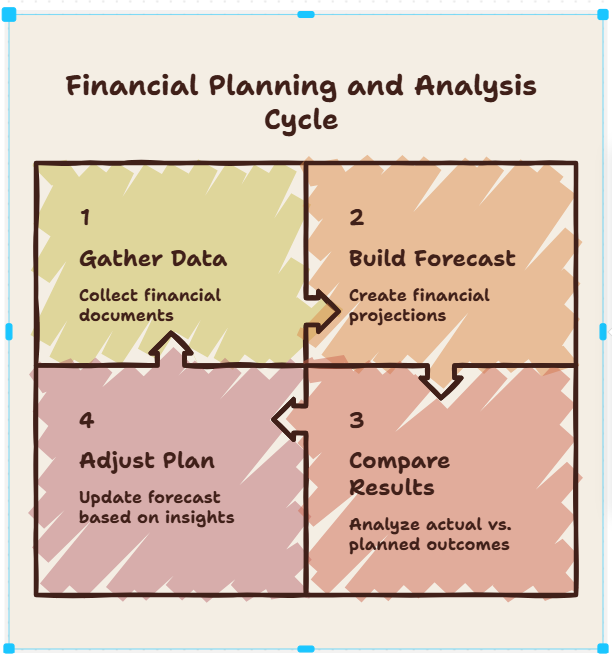
You don’t need a big budget or a finance degree. Here’s a simple four-step process.
Step 1: Gather Your Data
Pull last year’s profit and loss statement, balance sheet, and cash flow statement. Also, get your bank statements for the last six months.
Step 2: Build a Simple Forecast
Forecast revenue, expenses, and cash for the next three months. Do it in Excel or Google Sheets. Keep it simple.
Step 3: Compare Actual vs. Plan
Each month, write down your forecast vs. actual results. Note big differences. Investigate why they happened.
Step 4: Adjust and Repeat
Use what you learn to update next month’s forecast. That’s the loop of Financial Planning and Analysis plan, track, learn, adjust.
Pro tip: Spend no more than two hours per week on FP&A in a small business. If it takes longer, simplify.
Financial Planning and Analysis (FAQ)
What is the difference between FP&A and traditional accounting?
Accounting records what happened. Financial Planning and Analysis looks forward, it helps you decide what to do next.
How often should I update my financial forecast?
Most businesses benefit from a monthly update. High-growth or cash-sensitive businesses may do weekly updates.
Do small businesses need Financial Planning and Analysis?
Yes. Even a solo entrepreneur benefits from a simple cash flow forecast. You don’t need a full FP&A department, just the mindset.
What tools are best for FP&A?
- Small business: Excel, Google Sheets, or Fathom
- Mid-size: Planful, Vena, or Datarails
- Enterprise: Anaplan, Oracle, or SAP
Start with what you have. Upgrade when simplicity no longer works.
How does Financial Planning and Analysis help with fundraising?
Investors and lenders want to see that you understand your numbers. A solid FP&A process shows them you’re professional, prepared, and less risky.
Can FP&A prevent business failure?
It can’t prevent all failures, but it dramatically lowers your risk. Most failing businesses run out of cash before they run out of ideas. FP&A helps you see that coming.
Conclusion
Financial Planning and Analysis isn’t just for finance teams. It’s for any business owner who wants to grow with confidence and avoid nasty surprises.
You don’t need complex models or expensive software. Start small. Track your cash. Update your forecast monthly. Compare actual results to your plan. Then adjust.
The businesses that survive and thrive aren’t the ones with the most money. They’re the ones that plan, analyze, and adapt. That’s exactly what Financial Planning and Analysis helps you do.
So open that spreadsheet, or grab a notebook. Start asking better questions about your numbers. Your future self will thank you.
