

When you look at your bank account, do you feel confused or worried? You are not alone. Many people work hard but don’t know where their money is going. That is exactly where a financial advisor creates value. But not just any advisor. A certified financial advisor builds a clear, living roadmap that turns your stress into a step-by-step plan for lifelong wealth.
Think of it like building a house. You need blueprints. Without them, you waste time, money, and energy. The same is true for your money. In this guide, we will show you exactly how a financial advisor creates a personalized strategy that grows with you from your first job to a comfortable retirement.
What Does a Financial Advisor Actually Do?
A financial advisor is not just for rich people. They are like a fitness trainer for your money. They look at your whole picture: income, debts, savings, goals, and fears. Then, a skilled financial advisor creates a bridge between where you are today and where you want to be in 10, 20, or 30 years.
A certified financial advisor goes further. They have passed strict exams and follow ethical rules. They must act in your best interest, not theirs. This is critical for building trust and long-term success.
The 5-Step Process Behind Every Strong Financial Plan
Step 1 – Understanding Your “Why” (Goal Setting)
Before talking about stocks or bonds, a good advisor asks simple questions:
- What does “wealth” mean to you? (A house? College for kids? Travel?)
- When do you want to retire?
- What keeps you up at night?
This step is emotional, not mathematical. A financial advisor creates a plan based on your life, not a spreadsheet.
Step 2 – Taking a Honest Snapshot of Your Current Money
You cannot fix what you do not measure. Your advisor will help you list:
- All income sources
- Monthly expenses (rent, food, subscriptions)
- Debts (credit cards, student loans, mortgages)
- Existing savings and investments
This is often the first time people see their real numbers. It can be shocking. But it is also empowering.
Step 3 – Building Your Safety Net (Emergency Fund & Insurance)
A roadmap without protection is dangerous. Before investing a single dollar, a certified financial advisor ensures you have:
- 3 to 6 months of living expenses in a safe, easy-to-access account.
- Proper health, life, and disability insurance.
Why? Because one medical bill or car repair can wipe out years of progress. Safety first.
Step 4 – Creating a Smart Debt Payoff & Savings Plan
Not all debt is bad. A mortgage at 3% is different from a credit card at 22%. Your advisor will help you prioritize:
- Pay off high-interest debt aggressively.
- Automate savings into tax-advantaged accounts (401k, IRA, 529 for kids).
Here, the financial advisor creates a monthly cash flow plan that feels realistic, not painful.
Step 5 – Investing for Long-Term Growth (The Wealth Engine)
This is what most people think of. But now it comes last, after the foundation is solid. Your advisor will recommend a diversified mix of:
- Low-cost index funds
- Bonds (for stability)
- Maybe real estate or other assets
They rebalance this mix every year. They also protect you from panic-selling when the market drops.
Key Benefits of Following a Certified Financial Advisor’s Roadmap
Why hire a professional? Here are the real-world benefits that clients report.
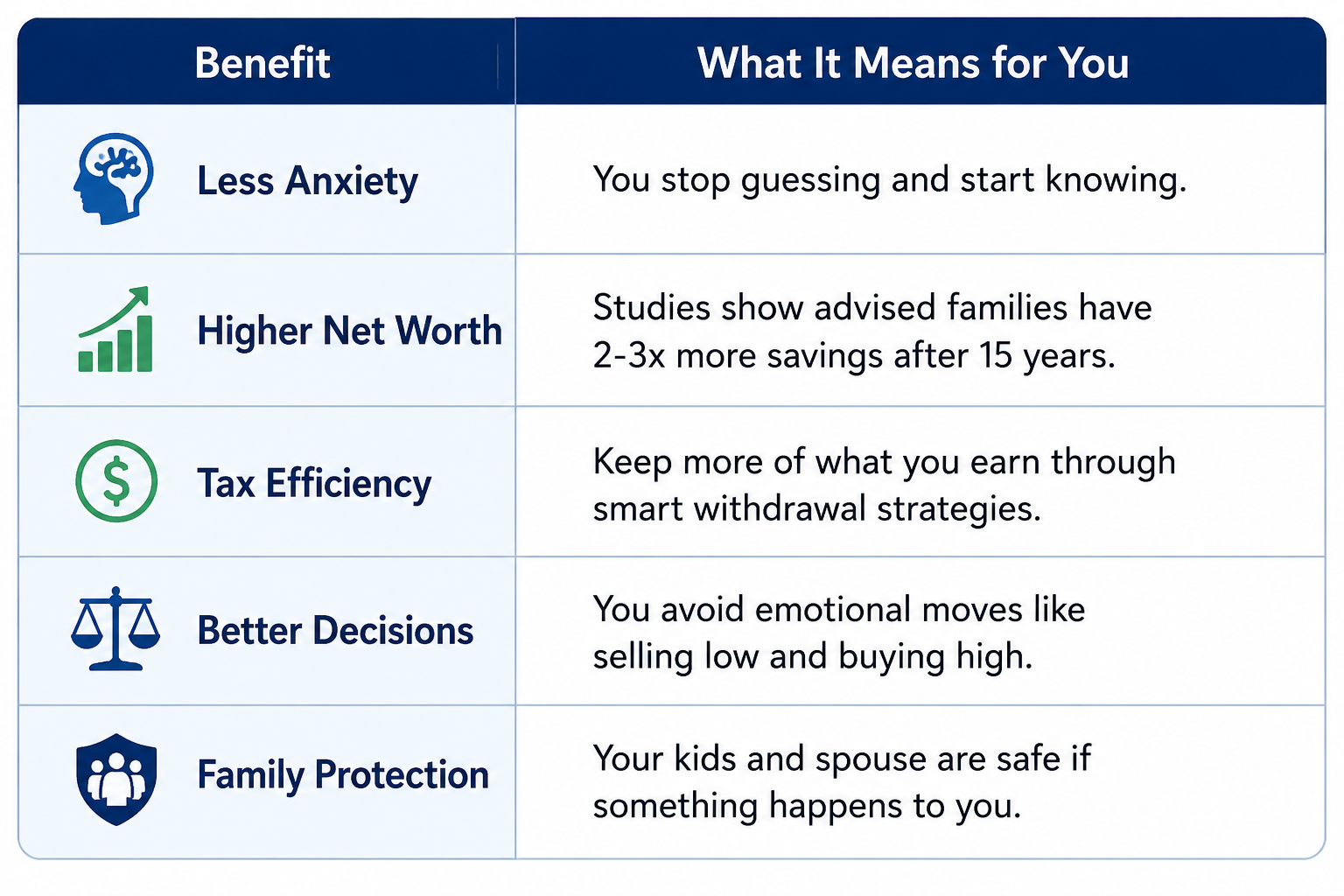
A certified financial advisor creates not just wealth, but peace of mind. That is priceless.
4 Common Mistakes People Make Without a Financial Roadmap
Even smart people make these errors. Avoid them.
- Saving but not investing – Cash under the mattress loses value to inflation every year.
- Chasing hot stocks – This is gambling, not planning. It rarely works long-term.
- Ignoring fees – Small 1% fees eat 30% of your returns over 30 years.
- No plan for taxes – You could lose half your 401k to the IRS if you withdraw wrong.
When a financial advisor creates your roadmap, they block these common traps automatically.
Expert Tips from a Certified Financial Advisor
We spoke with senior advisors from the National Association of Personal Financial Advisors. Here are their top tips for this year:
- Start before you feel “ready.” You do not need $100k. Many advisors work with clients who have just $5,000.
- Look for a fiduciary. That is the magic word. It means they are legally required to put you first.
- Expect a roadmap that changes. Life happens. Marriage, kids, job loss. A good advisor updates your plan every 6–12 months.
- Use technology. In 2026, most advisors use apps that show your entire net worth in real time. Ask for that.
Real insight: The best time to plant a tree was 20 years ago. The second best time is today. The same is true for your financial roadmap.
Frequently Asked Questions (FAQ)
Q1: Do I really need a financial advisor if I’m not rich?
Yes. A financial advisor creates systems that work for any income level. Many people with moderate incomes actually benefit more because they have less room for mistakes.
Q2: How much does a certified financial advisor cost?
It depends. Some charge a flat fee ($1,500–$5,000 per plan). Others charge an annual retainer or a small percentage of assets (0.5%–1% per year). Always ask for clear pricing upfront.
Q3: What is the difference between a financial advisor and a certified financial planner (CFP)?
A CFP is a specific certification. Every CFP is a financial advisor, but not every advisor is a CFP. A certified financial advisor (CFP) has more training and must act as a fiduciary. Choose the certified one.
Q4: How long does it take to see results from a financial roadmap?
You will feel less stress in the first month. Real wealth growth usually takes 5–10 years of consistent following the plan. Patience is key.
Q5: Can a financial advisor help with retirement planning specifically?
Absolutely. A retirement planning advisor works with you to project your expenses, optimize Social Security, and create a withdrawal strategy so you never run out of money.
Conclusion
Building lifelong wealth is not about luck. It is not about making millions quickly. It is about having a clear, realistic, and personalized roadmap. That is exactly what a certified financial advisor creates for every client. From your first emergency fund to your last retirement check, they walk with you.
Whether you call them a wealth management advisor, a financial planning advisor, or the best certified financial advisor in your town, the role is the same: to turn your financial fog into a step-by-step path forward.
Do not wait for the “perfect time.” That time does not exist. But a good roadmap does. Reach out to a certified professional today. Your future self will thank you.
