

Explore the Sensex Index Today with market performance, stock market trends, investment opportunities, Sensex vs Nifty insights, and expert analysis.
Introduction
The Sensex is one of the most important indicators of the Indian stock market. Investors, traders, financial analysts, and businesses closely monitor the Sensex every day to understand market sentiment and economic conditions. When the Sensex rises, it often reflects investor confidence and positive market expectations. When it falls, concerns about economic growth, global events, or company earnings may influence investor behavior.
As of June 2026, the Indian stock market continues to experience volatility due to global geopolitical developments, crude oil price movements, foreign investor activity, and domestic economic factors. Despite these challenges, the Sensex remains a key benchmark for measuring the performance of India’s largest companies.
What Is the Sensex Index?
The Sensex, officially known as the S&P BSE Sensex, is the benchmark stock market index of the Bombay Stock Exchange (BSE). It tracks 30 of the largest and most actively traded companies listed on the exchange.
The index represents multiple sectors including:
- Banking
- Information Technology
- Energy
- FMCG
- Automobile
- Healthcare
- Telecommunications
Because these companies represent a significant portion of India’s market capitalization, the Sensex provides a snapshot of the overall health of the Indian stock market.
Sensex Today: Current Market Performance
Indian equities showed strength during today’s trading session. The Sensex traded above 74,400 points while the Nifty crossed 23,300, supported by gains in large-cap stocks including Reliance Industries and other major market contributors. Market sentiment improved despite ongoing geopolitical concerns in the Middle East. Recent gains were supported by easing crude oil concerns and positive investor sentiment.
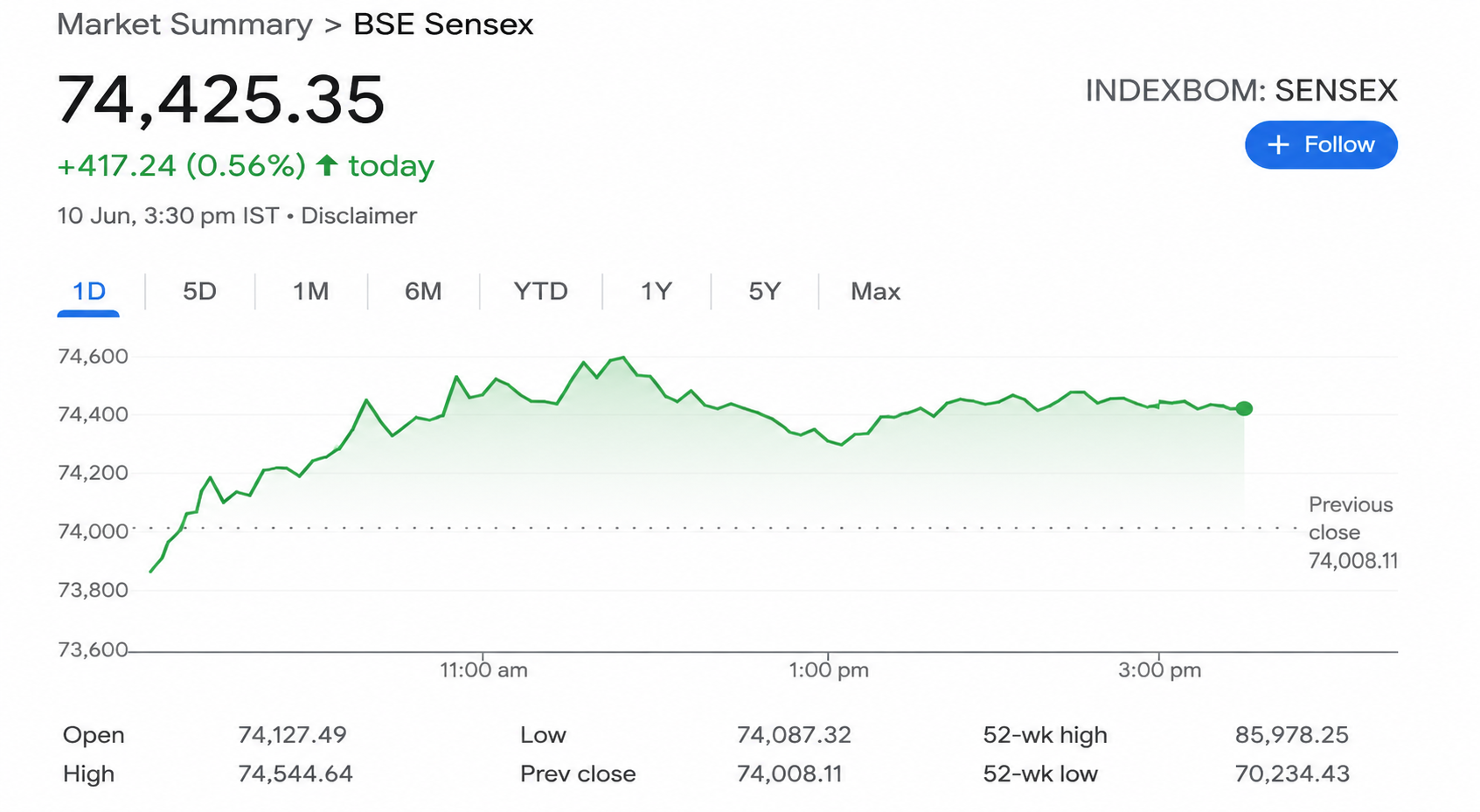
Recent market activity indicates:
- Strong participation from large-cap stocks
- Positive movement in consumer and financial sectors
- Continued focus on global economic developments
- Increased attention to foreign institutional investor flows
Why Is the Sensex Moving Today?
Several factors are influencing the market:
1. Global Geopolitical Developments
Investors are closely monitoring tensions in the Middle East. Any escalation can impact oil prices and create uncertainty in global financial markets.
2. Crude Oil Prices
India imports a significant portion of its crude oil requirements. Lower oil prices generally support economic growth and improve investor sentiment. Recent easing in oil-related concerns has helped support the market rally.
3. Corporate Earnings
Strong earnings from major companies can boost investor confidence and support higher market valuations.
4. Foreign Investor Activity
Foreign Institutional Investors (FIIs) continue to play a significant role in market movements. Their buying and selling decisions often influence short-term market direction.
Historical Performance of the Sensex
The Sensex has delivered significant long-term growth over the years despite periods of volatility.
Major milestones include:
- Crossing 10,000 points
- Reaching 50,000 points
- Achieving record highs above 86,000 during 2025
- Continuing to remain one of Asia’s most closely watched stock indices
Long-term investors have historically benefited from staying invested through market cycles rather than attempting to time the market.
Sensex vs Nifty: Which Is Better?
Many investors compare the Sensex with the Nifty 50.
Both indices serve as important indicators of market performance and are widely used by investors.
How Investors Can Analyze the Sensex
Technical Analysis
Investors use:
- Moving Averages
- Relative Strength Index (RSI)
- MACD Indicators
- Support and Resistance Levels
Fundamental Analysis
Key factors include:
- GDP Growth
- Inflation Rates
- Interest Rates
- Corporate Earnings
- Government Policies
Combining both approaches often provides a more complete understanding of market conditions.
Investment Opportunities in Current Market Conditions
Current market conditions continue to create attractive investment opportunities for investors following the Sensex Index Today and the Indian Stock Market Today. Despite market fluctuations, strong economic growth and positive stock market trends are supporting several sectors. Investors should focus on quality companies and maintain a long-term investment approach.
Banking Stocks
Banking stocks remain a major driver of Sensex performance and play a crucial role in the Indian economy. Strong credit growth, increasing digital banking adoption, and expanding financial services continue to support the sector. Many investors consider banking stocks a valuable option for share market investment and long-term growth.
Technology Companies
Technology companies continue to be important contributors to the Indian stock market. Growing demand for software services, cloud computing, and digital transformation supports the sector’s growth potential. As a result, technology stocks remain a key part of many investment portfolios and Sensex analysis reports.
Consumer Goods Companies
Consumer goods and FMCG companies often provide stability during uncertain market conditions. Their strong brands, steady demand, and consistent revenue make them attractive to investors seeking lower-risk opportunities. These companies frequently perform well during changing stock market trends.
Diversified Portfolios
A diversified portfolio helps investors reduce risk while benefiting from different sectors of the economy. By investing across banking, technology, consumer goods, and other industries, investors can improve their chances of long-term success. Diversification remains one of the most effective strategies in the Indian stock market today.
Common Mistakes Investors Make
Many investors lose money because they:
- Follow market rumors
- Panic during corrections
- Ignore risk management
- Invest without research
- Attempt to time the market perfectly
Successful investing generally requires patience, discipline, and a long-term perspective.
Future Outlook for the Sensex
Market experts remain cautiously optimistic about India’s long-term growth story. Economic expansion, infrastructure development, digital transformation, and rising domestic consumption continue to support long-term market potential.
However, investors should monitor:
- Interest rate decisions
- Global economic conditions
- Oil price movements
- Foreign investment flows
- Corporate earnings growth
These factors will likely determine the future direction of the Sensex.
Frequently Asked Questions
What is the Sensex Index today?
The Sensex Index Today refers to the current value and performance of the Bombay Stock Exchange’s benchmark index. It tracks 30 leading companies across various sectors and helps investors understand the overall direction of the Indian stock market today.
Why is the Sensex important?
The Sensex is an important indicator of stock market performance and investor confidence. It provides insights into market trends, economic conditions, and the performance of some of India’s largest publicly traded companies.
How is the Sensex calculated?
The Sensex is calculated using the free-float market capitalization method, which considers only the shares available for public trading. This method helps provide a more accurate representation of the market value of the companies included in the index.
What causes the Sensex to rise or fall?
Several factors influence Sensex performance, including corporate earnings, economic growth, inflation, interest rates, foreign investor activity, crude oil prices, and global market developments. Positive news generally pushes the index higher, while negative events may lead to declines.
Is the Sensex a good indicator of the Indian economy?
Yes, the Sensex is widely considered a useful indicator of the Indian economy and stock market trends. Although it does not represent every company in the market, it reflects the performance of major businesses and overall investor sentiment.
Conclusion
The Sensex remains one of the most important indicators of India’s financial markets. Whether you are a beginner or an experienced investor, understanding Sensex performance, market trends, and economic factors can help you make better investment decisions. While short-term volatility is inevitable, a disciplined and research-based approach remains the best strategy for long-term success.
